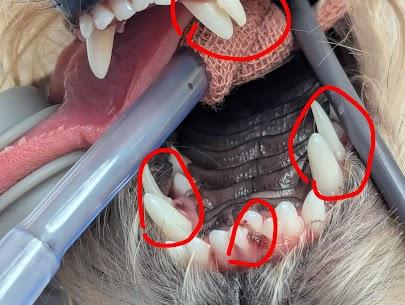
Puppies usually start losing their baby teeth and growing adult teeth between 4–6 months of age.
Today, a young Yorkie came in for a spay procedure—and we also had to remove 6 retained baby teeth that never fell out. One of the adult front teeth was literally “trapped” between two baby teeth, like a big brother being squeezed from both sides.
Why is it so important to remove retained baby teeth early?
If baby teeth do not fall out on time, they can block the normal direction of adult teeth, leading to crooked teeth and bite problems. When we remove the retained teeth early enough, the adult teeth still have a good chance to move back into a healthier position—just like orthodontics works best during teenage years in people.
Crowded or double rows of teeth also create many hidden food-trapping areas, which can quickly lead to severe tartar buildup, gum disease, tooth decay, and bone loss.
👉 Small breed dogs need extra attention.
Small dogs are genetically more likely to develop retained baby teeth than large breeds.
Even more importantly, a small dog’s tooth roots can occupy 60%–80% of the height of the jawbone. That means once dental disease develops, small dogs are far more likely to suffer from jawbone thinning and even fractures.
Prevention is always better than treatment.
At River Park Animal Hospital, we strongly encourage pet parents to monitor their puppy’s teething stage closely—especially if you have a small breed. Early dental checks can help protect.